


|
基本信息Personal Information
研究员(自然科学) 博士生导师 硕士生导师
性别 : 男
毕业院校 : 中国科学院大连化学物理研究所
学历 : 博士研究生毕业
学位 : 博士学位
在职信息 : 在岗
所在单位 : 杭州高等研究院
办公地点 : 杭州高等研究院童趣楼101-2
联系方式 : 0571-82257902
Email :
20260713_ZnZrOx和Zn/SSZ-13耦合催化剂上丙烷-CO2氧化脱氢的合作论文被Journal of Catalysis接收!
发布时间 : 2026-07-13 点击量 :
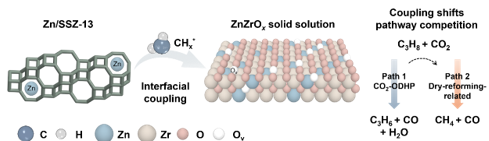
Proximity-enabled pathway competition in propane/CO2 conversion over coupled ZnZrOx and Zn/SSZ-13 catalysts
Shuwen Huang+, Xiao Jiang+, Yulin Jiang, Yu Xu, Peng Guo, Chunyan Liu, Chong Peng, Shaoyun Chen, Zhichao Sun, Ronghe Lin*, and Jiaxu Liu*
Abstract
The conversion of propane with CO2 as a soft oxidant offers a promising route for light-alkane valorization, but achieving high activity, selectivity, and stability within a single catalyst remains challenging. Here, we systematically investigate ZnZrOx mixed oxides and their coupling with zeolite-confined Zn species in Zn/SSZ-13 for propane/CO2 conversion. Across the ZnZrOx series, moderate Zn incorporation stabilizes a defect-rich tetragonal solid solution, whereas excessive Zn loading induces segregation of crystalline wurtzite ZnO. This composition-dependent structural evolution gives rise to a volcano-type activity trend, with 23% ZnZrOx showing the highest overall propane/CO2 conversion. Product analysis further shows that pure ZnZrOx operates predominantly in a dry-reforming-related regime, as indicated by CH4 and CO as the dominant carbon-containing products and by near-unity formation rates, rather than in a propylene-centered dehydrogenation regime. To redirect the reaction network, Zn/SSZ-13 is introduced as a complementary component with a distinct Zn environment that favors early propane activation and olefin formation. The resulting ZnZrOx / Zn/SSZ-13 coupled catalysts exhibit clear nonadditive behavior, with product formation rates exceeding composition-weighted additive expectations at intermediate mixing ratios. This synergy is strongly proximity-dependent and preferentially enhances deeper CO2-involving conversion channels. CO2-TPD, C3H8-TPD and in situ IR measurements further show that catalyst coupling reconstructs the propane-related surface response and modifies the early evolution of hydrocarbon-related surface species. Together, these results establish a proximity-enabled competitive reaction network in which dehydrogenation and dry-reforming-related conversion coexist, with the balance between these pathways governed by the spatial arrangement and compositional interplay of the two catalyst components.