


|
基本信息Personal Information
研究员(自然科学) 博士生导师 硕士生导师
性别 : 男
毕业院校 : 中国科学院大连化学物理研究所
学历 : 博士研究生毕业
学位 : 博士学位
在职信息 : 在岗
所在单位 : 杭州高等研究院
办公地点 : 杭州高等研究院童趣楼101-2
联系方式 : 0571-82257902
Email :
20260612_Ru/NC上异壬醇氧化到异壬酸的论文被Chemistry - A European Journal接收,祝贺2023级研究生陈静意!
发布时间 : 2026-06-12 点击量 :
Metal–Support Synergy in Nitrogen-Doped Carbon Supported Ru Nanoparticles Enables Base-Free Aerobic Oxidation of Isononanol to Isononanoic Acid
Jingyi Chen,[a] † Shuangfeng Ren,[a, b] † Zizheng Liu,[a] Xiaoling Mou,*[a] Ping Fang,*[c] Ronghe Lin.* [a]
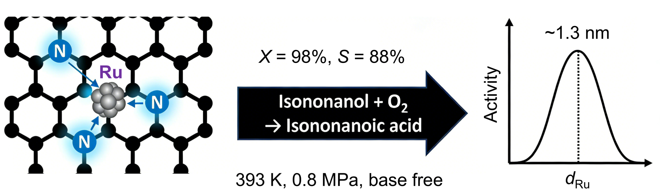
Abstract: Selective aerobic oxidation of long-chain primary aliphatic alcohols to the corresponding carboxylic acids remains a fundamental yet industrially challenging transformation, particularly under base-free conditions. Herein, we report a systematic investigation of Ru nanoparticles supported on nitrogen-doped carbon (Ru/NC) for the oxidation of isononanol to isononanoic acid using molecular oxygen as the sole oxidant. By tailoring the thermal treatment atmosphere and temperature, the particle size and surface oxidation state of Ru were precisely regulated. Among the catalysts examined, Ru/NC reduced in H2 at 523 K exhibited optimal performance, affording 98% conversion and 88% selectivity to isononanoic acid at 393 K and 0.8 MPa O2 after 24 h without any added base. Structure–activity correlation reveals a volcano-type dependence of activity on Ru particle size with an optimum around 1.3 nm, and a strong positive correlation between surface Ru0 fraction and catalytic performance. The N-doped carbon support not only stabilizes highly dispersed Ru nanoparticles but also modulates their electronic structure via metal–support interactions. Catalyst deactivation is primarily attributed to Ru leaching and nanoparticle sintering. This study provides mechanistic insight into Ru-catalyzed oxidation of high-carbon aliphatic alcohols and highlights the critical role of controlled reduction in achieving efficient, base-free oxidation systems.